To reward or to punish?

20121026-193809.jpg
For someone who has had the pleasure of teaching a wide variety of subjects (namely: economics, business studies, statistics, humanities, English/ESL and Drama), I believe classroom management in a drama classroom is a bigger challenge than the others. Firstly, the environment is a lot more open and students are not seated on desks and chairs, which can be an intimidating factor for a lot of teachers. Secondly, drama activities and processes are often noisy and require teachers that are comfortable with noisy classrooms and know how to handle them. Thirdly, drama activities often push students to a level of self-awareness that they do not experience often and this can make a lot of them uncomfortable, which often translates in them playing up in an attempt to hide their self-consciousness.

An added challenge for me is the fact that drama is only timetabled as one double-period for every class per week, and we are expected to assess every criterion at least twice during a semester. When the teacher factors in the periods that will be lost due to excursions or public holidays or school events, or even absences, in the end you are left with approximately 16 double-periods per class per semester (each double-period is about 90 minutes long). Also, assessments should be carried out prior to writing reports which is during the sixth and seventh weeks of the term. Therefore, I often feel like I am racing to teach the content and skills, get the students to practice and apply those skills enough times, and then assess the drama process, and classroom management can often slow that down drastically and makes it more challenging.

Over my teaching experience, I have come to learn, adapt and create a number of classroom rules and procedures to make classroom- (and behavior-) management more ‘manageable’. I have learned to keep the rules simple and easy to remember. I have read that rules should be no more than five. I have come to know that rules should tell students what to do as opposed to what not to do, so instead of saying ‘don’t hit, kick or punch other classmates’, apparently it’s better to say ‘keep hands and feet to yourself’. I took every bit of advice I came across and I tried to adapt it in my classroom. I can say I am pleased with my ability to manage my classroom now, however, it still is a challenge that never ends.

For me, one of the most challenging aspects of classroom management is what behaviors to reward, when and how, and what behaviors to punish, when and how. In a class of 25 students, it is hard to keep track of positive and negative behaviors and to respond to every one of them. Of course, as humans, we tend to notice negative behaviors more than we do the positive ones, so teachers must be conscious and careful of that tendency. I have come to devise a few positive consequences for good behavior, and negative consequences for bad behavior.

Positive consequences for good behavior

1- Verbal Praise: simple, kind words of recognition for a student’s work or behavior go a very long way.
2- Using the Whiteboard: I have found that writing a list of students who are ‘on-task’ or ‘appear to be working well’ on the whiteboard can accomplish a lot. Students notice when others receive this recognition and try to imitate their behavior in order to get their names written up on the whiteboard. I also occasionally review and revise this list throughout the lesson to add more students or remove students who may have started to get distracted or off-task.
3- Merit Points: since I teach middle schoolers now, this system seems to work very well. I always inform my students what sort of behaviors will warrant a merit point at the end of the lesson, and tell them that they will be assigned during the last couple of minutes before the bell.
4- Merit Certificates: I try to keep a track of the upcoming year-level assemblies and prepare some merit certificates for the best students, usually they are the ones that have gathered the most merit points in the classes. These certificates are signed by the year-level coordinator and so that adds more recognition to them.
5- Stickers: sounds cliche, but yes it still works! I had my year 10s begging me for stickers last year.

I generally do not like to give material prizes like candy or stationary because I believe in intrinsic motivation, and I aim to build that in my students. Also, there are so many food allergies now, so one has to be very careful about any food brought into the classroom.

Negative consequences to correct certain behaviors

Behavior regulation chart: I have a poster chart on the whiteboard with six columns: name, warning, time-out, behavior-reflection form, behavior-checklist sent home, detention. It looks something like this:

20121026-083725.jpg

This chart is printed, laminated and hung up on the whiteboard top-right corner. The students are taught early on, and constantly reminded of, what sort of behaviors are acceptable and what sort of behaviors are not. The teacher can just write the name of the student and then tick the appropriate column. It’s best to start with a warning, and quietly inform the student what behavior you are warning against (make it short and simple, and so as not to embarrass the student, do it quietly between you two only). If the student does not self-correct, you can then choose the most appropriate consequence depending on the behavior. It’s very important to practice consistency: if talking-out-of-turn warrants a warning followed by a behavior reflection survey, then stick to it with all other students. This can be quite challenging as you will have some days where you might be more anxious or tense, but always try to be consistent and fair.

It is also very important to always have a quiet one-on-one chat with the student at a time when his/her peers are not around, where you can question the student to probe the reasons behind him/her choosing to behave that way. Keep this chat friendly but firm, and do not let it turn into an interrogation. You want the student to know that you have nothing against them personally, but it’s rather their behavior that you want to change or correct.

The behavior-reflection form was an idea I got from lauracandler.com and it looks like this:

20121026-083809.jpg

Not all incidents will require getting a parent’s signature. When I need a parent’s signature (which is usually the next step if the behavior continues) I often send home a behavior-checklist that looks like this:

20121026-083929.jpg

I still haven’t decided what is the best way to use this behavior regulation chart, is it best to make it progressive, where students take a step up the punishment ladder every time the behavior continues? Or can I reserve the right to choose the consequence to my judgment (after giving the warning of-course)? Richard Curwin wrote a very nice article about how the progressive system isn’t always fair.

What other positive and negative consequences do you use with your classes to reinforce positive behavior and correct negative behavior? What strategies do you use to stay consistent with your classes and to manage their behaviors?

Introducing Slapstick Comedy to the year 7s!

Today, we started a new unit of work on ‘Slapstick Comedy’. This unit of work is designed for the year seven group. The students had a quick circle warm-up where one student would call-out an emotion and the rest would mirror that emotion with a lot of exaggeration, using body language, facial expressions, gestures, poses. The students laughed a lot at some of the responses.

After a quick debriefing/oral reflection about the warm-up and the skills involved, the students were divided into groups of 3 or 4 participants, and each given a piece of poster paper and a few markers. The students had to then watch ‘Gangnam Style‘ and respond to these three questions (which I prepared earlier as a Tumblr post). While the brainstorming questions are not necessarily focused on ‘slapstick comedy’ per se, the aim was to get students to deconstruct humour in general and what makes certain things ‘funny’. These questions are from Tom March’s Look-to-Learn Tumblr blog.

While the students were responding to the three questions on the poster paper, one member of each group was withdrawn to bring their iPad and access the typewith.me EtherPad and input their group’s responses. The students were very engaged and keen to see each group’s response as they were writing it. Here is a screenshot of their responses and a photo of the brainstorm posters.

We then had a quick discussion about their responses and arrived at the unit of work’s ‘significant concept’ which is: Different people laugh at different things. The class followed that with a discussion of the unit of work’s ‘area of interaction focus’ and ‘MYP unit question’. To conclude the lesson, we had a quick reflection activity where the students set three personal learning goals for this unit of work, in written format. The lesson was quite engaging, made use of ICT and incorporated group-work, brainstorming, discussion and reflection. Next week, we will focus more on slapstick comedy and define it and start looking at its features/elements.

Student self-assessment: capitalizing on its benefits?

Assessment is a recurring theme in my blogging. I think that is because it was my biggest challenge when I started teaching. I wrote before how I thought that teacher-training programs do not prepare us sufficiently for our role as assessors as they do for our role as teachers. This blogpost will focus more on self-assessment and how I came to use it in my classroom. I am now a lot more comfortable with my use of student self-assessment in class, but it didn’t start as such. I would also like to invite other educators to comment and suggest other ways to fully capitalize on the benefits of student self-assessment.

The context is a unit of work on improvisational theatre for my year 7 drama classes. I always post the main content on the board for every lesson (imagine writing this four times a week for about six weeks!). Below is a copy of the whiteboard with the main learning material posted on it. Basically it is a simplified list of the features of the best improvisations and what the best improvisers do. We refer constantly to those two lists when the students give each other feedback on their performances, and when the students assess and evaluate their own performances.

20121019-090122.jpg

After having practiced improvisational skills for about five or six weeks through playing various improv games and theatresports, the students are given this task sheet that will be used to assess Criterion B (Application). They are told that this MYP Arts criterion is used to assess ideas, skills, techniques and processes. The students are then given a prompt for their improvisation, and the performances are filmed. After all performances, the students watch the video of their improvisations and then use the checklist in the task sheet to assess their performance.

20121019-090301.jpg

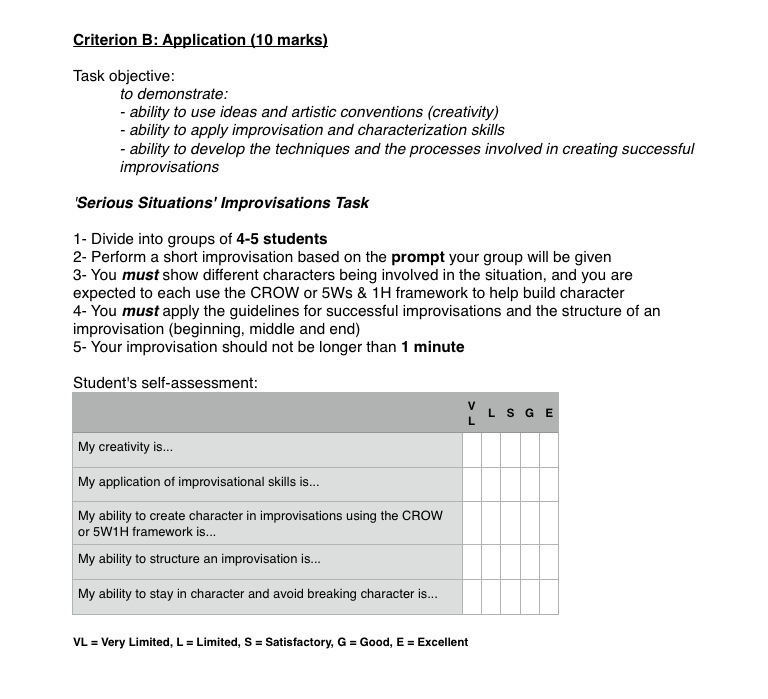
The last step required of the student is to use the self-assessment column in the rubric below to give themselves a mark out of 10 for Criterion B (Application).

20121019-090244.jpg

Last year, this process was already in place for me. However, I didn’t really know what the next step should be. I didn’t know how to fully bridge the gap between the student’s self-assessment and my own teacher’s assessment of their work. I did a lot of reading and professional learning on assessment, and I finally came across a fantastic alternative assessment tool: conferencing with the students. It seems very common-sensical, but in actual fact it wasn’t for me.

What I learned to do after the students use the checklist and the rubric to assess their work, is to conference with each one of them. I use this 2-3 minute chat (which I build into class-time), to probe further reflection. I ask questions such as: “Why did you give yourself this mark? What suggestions for improvement do you have for yourself?”. I also constantly remind them to refer to the guidelines for successful improvisations/improvisers written on the whiteboard for their oral reflection during the conferencing. Students are often (though not always) quite capable of evaluating their own work and formulating their own feedback for improvement. Of course, you will come across the students that under-assess themselves and those that over-assess themselves. I always remind the ones that under-assess their work that they are being too hard on themselves and focus on highlighting the positive aspects of their work. I also probe further reflection from those that over-assess themselves and ask them to see how they can improve. Using their performance, checklist, rubric self-assessment and the conference, I finally arrive at my own teacher-assessment, which I add to their rubric in the teacher assessment column, reminding them to use this discussion in the conference as their feedback for improvement.

I am now much more comfortable with the way I administer the task and assess the students, and with the way I allow students to assess themselves and evaluate their own work. However, I believe there is always room for improvement. I would like to invite teachers and educators to share their thoughts, views and suggestions.

ePeer eEvaluation?

I decided to take Peer Evaluation into the eLearning sphere. I experimented with my year 7 classes, as they have iPads. The students were registered into a class on edmodo.com. Earlier, I prepared this peer evaluation google form (picture of it below ) based on a template that I adapted from The DramaNotebook. I then posted the link to the peer evaluation form on the class’ Edmodo page. You can also embed the form into a blog/Edmodo, but with iPads it might be a bit tricky for students to view the whole form, so I chose to just post the link to the form, which they access through the Edmodo app.

The students were each anonymously assigned a peer to evaluate. Each group was then given a prompt for their improvisation (as a wrap-up of the unit-of-work on improv theatre). Each performance was filmed with an iPad. Once all performances were finished, I projected all the performances on the screen and then students started their peer evaluations.

An advantage of Google Forms is that you can hide certain columns, so I hid the columns that show the student names and projected the feedback they are giving each other, so it was all immediate and in real-time. The students were very engaged and enjoyed receiving this feedback in real-time, which prompted discussions about their responses to that feedback.

To drama or not to drama?

Drama-icon

Drama is a very powerful learning tool. There is lots of academic research in education to back this statement up. I will not be presenting arguments to back it up in this post. What I will be discussing is how I made use of drama, as a learning tool, in the other subjects that I teach (other than drama).

I have always been passionate about theatre and drama. But one thing frustrated me: a lot of the theatre programs I participated in, whether as a teacher or a student, were more focused on the show than on the learning experience for the participants. My passion for drama was a lot more educational than it was artistic. Maybe that is why I did not really feel that a career in theatre is what I wanted (and I did experiment with that path for a short period of time).

Also, I wasn’t just satisfied with a career as a drama teacher. I wanted to bring the educational benefits of drama into other subject areas. I wanted to find ways of integrating drama more into other curricula. I set out on a quest to find out how, and I experimented with a lot of tools. This is a post I wrote to share my experiences.

Firstly, there are a lot of theatre or drama conventions/strategies that drama teachers generally use with their students to help them analyze text to build character and to understand motivations and objectives. My first experiment with taking these tools outside the drama classroom was with conscience alley in my year 10 humanities class in 2011. This technique or convention requires students to form two lines facing each other (i.e. an alley) and one student plays a character facing a dilemma or a difficult decision. The student-in-role then walks through that alley, whilst being bombarded with advice and conflicting arguments. I used this technique to explore the motivations the Muslims may have had for invading Spain in the Middle Ages. One student stepped into the role of the Caliph at the time, while the dilemma was ‘to invade Spain or not to invade Spain’. The students had to quickly read through the text and come up with arguments for and arguments against invading and bombard the Caliph with their arguments as he/she walked through the alley. This activity was then used as a basis for a reflective journal entry in which students had to weigh up the arguments and solve the dilemma. The students thoroughly enjoyed the activity and were very engaged, and I believe the activity improved their arguments in the journal entry. They even requested more similar activities being brought into the humanities classroom.

Later on, I experimented with hot-seating, where a student would step into the role of one of the historical figures studied, and be interviewed by the class in a sort-of press-conference-setting. This activity requires the students to have some good background information about the historical figures, but also there is a lot of room for creativity and just having fun with improvisations. Mantle-of-the-expert was yet another drama strategy that I used in the same unit of work about the ‘Islamic History of Spain’. The students studied the achievements of the Islamic world during the Golden Age of Islam, and so some students were assigned the role of a panel of experts from the various fields of achievements (astronomy, mathematics, geography, agriculture, poetry etc…). The class would then interview that panel of ‘experts’ about their contributions to the Golden Age of Islam.

This year, I used thought-tracking to explore the thoughts and feelings certain characters may be having during certain parts in a novel studied in my year 8 English classroom. A student would be asked to step in role and voice the thoughts and feelings of the assigned character at a certain stage in the novel. I also made use of the other drama strategies mentioned earlier, and I noticed a much higher level of engagement from the students and deeper reflections when these activities were used as a stimulus for journal-writing.

Earlier this year I designed an assessment framework (as part of my masters) that relies wholly on drama strategies as a stimulus for speaking and writing, and to assess reading and listening. This was when I came across this fantastic resource: Joe Winston’s book ‘Second Language Learning Through Drama’. I would highly recommend it for any teacher interested in integrating drama more into their classroom, even if they do not teach drama. I also found the Swansea Grid for Learning literacy resources to be very useful, especially this leaflet.

The advantages I observed of using drama as a learning tool in the classroom are:

  • Engagement: I noticed students were a lot more engaged and interested in the material studied, even if they did not necessarily want to participate in the drama activity, they were still keen to watch their classmates perform.
  • Kinaesthetic learning: these drama strategies require a lot of movement and can appeal more to students that get restless when sitting down and writing for too long.
  • Great stimulus or prompt for a writing task: as it allowed students to dig deeper into the text and actually step into the role of the characters or historical figures, which improved their understanding. This was in turn reflected in their writing.
  • A practical and authentic formative assessment tool: to see whether or not the class have understood the content or the text.

However, there are challenges that teachers should be aware of:

  • Not all students will be keen to participate at first: of course, not everyone likes to perform because they may be shy or self-conscious. I found that slowing introducing these activities and encouraging students to try their best eventually led to full participation. I told my students that trying something new for the first time is the hardest, like riding a bike for the first time, but the more you do it, the more confident you become at it.
  • It will often get noisier: I noticed that students get very excited when I apply these strategies in class and this can led to them being noisier. Moreover, the strategies themselves do encourage a lot of talking. Just relax at first and understand that while they are noisy, it does not mean they are not learning. Just be clear about your expectations and set up an easy class signal to get back their attention.
  • These activities are not a panacea: they are engaging strategies that can be added to a big repertoire of other teaching activities. Naturally, a teacher should have many diverse tools and tricks in their teaching arsenal to appeal to all learning styles, and ensure that everyone is learning.

I hope this reflection on my experiences with drama outside the drama classroom was helpful and that you may take at least one thing out of it. Now, it’s your decision: To Drama or Not to Drama? Maybe set up a conscience alley to help you decide 😉

My MYP Drama Assessment Framework

When I started teaching MYP Performing Arts (Drama), I had very little to work with. The school had no drama curriculum in place, as it was never previously taught. The library was very under-resourced. The staff only thought of drama as a big school production, not as a subject with specific skills that can be taught, practiced and assessed.

I struggled to gather the necessary resources, and to set up a curriculum using the MYP Unit Planner (as a template for my units of work) and the MYP Arts Guide. My biggest struggle, however, was building an assessment framework that was efficient to administer, practical, valid, authentic and reliable. Before going on to describe my assessment framework, after several trials of refining, I will first explain the challenges I face at my workplace:

  • Performing Arts is only timetabled as one double-period per class per week (compared to six periods for English, for instance). Since a term is about ten weeks, I end up seeing each class an average of seven to eight times a term, when you factor in the lessons cancelled due to excursions, incursions, school-events, sports-events etc… I teach each class for a semester (two terms), and I have two units of work (one unit of work per term).
  • Performing Arts is timetabled as a compulsory subject for years 6, 7 and 8. This means that I will get a lot of students who don’t want to be there, either because they’re shy/self-conscious or they don’t care much for the arts, or both.
  • Most students come from families that also do not appreciate the arts due to cultural or religious reasons. For this reason, many students show indifference towards the marks they earn in the subject, and those that excel are not often recognized for it by their parents.

This assessment framework is a product of many trails and errors, and there is always room for improvement and feedback.

Assessment Criterion A: Knowledge & Understanding

This criterion was often hard for me to assess because I did not want to allocate too many double-periods for theoretical work. I tried worksheets with comprehension questions to accompany a PowerPoint presentation, but that was very disengaging for the students (not to mention very boring for me as a teacher). Additionally, I came to realize that it’s not a very reliable way of assessing understanding, because it just encouraged copying the answers directly from the PowerPoint.

Then, a very helpful friend of mine suggested that I should get the students to talk about what they learned, as that is a more reliable measure. So, I decided to photocopy some handouts from books, and design an oral presentation task where the students read the information, summarize it (guided by questions), supplement it with additional research, and then teach it to the rest of the class through an oral presentation.

This task is more practical to administer as it does not involve collecting worksheets and marking them, which is time-consuming, and also because it allows the students to talk about what they learned which is a more reliable measure of their understanding. I also give the students some basic information to help them answer the questions, while allowing the ones who want to excel the opportunity to research for additional information. Each student is also assessed individually as they are presenting. This whole assessment process can be started and finished in the same double-period, or over two double-periods if students want more time to research.

Below are sample tasks used to assess knowledge and understanding in a unit of work on Improvisational Theatre. These tasks assess the first two strands of the criterion, which require students to “demonstrate knowledge and understanding of the art form studied… and elements of the art form studied”. The last strand of Criterion A, which requires the students to “communicate a critical understanding of the art form studied…”, is assessed through asking students to evaluate a peer’s performance and express an opinion on it using this form: Peer evaluation

Criterion A sample task #1 and sample task #2 used to assess first two strands. Below is a screen-cast describing one task and how it is administered.

Criterion B: Application

The buzzwords I use with my students to explain this criterion are: ideas, skills, techniques, and processes. Therefore, the tasks I create to assess this criterion have to flesh out these four elements. Additionally, I often assess this criterion summatively, at the end of a unit of work, while I use the other criteria for my formative assessment. This is because it allows the students a whole term to demonstrate knowledge and understanding of the art form; practice the skills, techniques and processes involved in the unit of work; and reflect on and evaluate their work before I finally assess their application of those skills, techniques and processes.

Below is a sample task I use to assess Criterion B (Application) in a unit of work on Improvisational Theatre. The students are given the task sheet, told that they will be organized into groups and given a prompt. A visual timer is then used to give the students a minute to quickly discuss/prepare their performance based on the prompt (as they are aware that an improvisation is unscripted and unrehearsed). During this preparation phase, I will jot down some notes to see if they’re applying the correct processes and techniques involved (such as using the CROW [Characters, Relationships, Objective and When/Where] framework to prepare their performance). The students then perform their improvisation, and video footage is taken of their performance to help them in the self-assessment/self-evaluation that follows. After their performance, the audience members are asked to ‘play director’ by giving positive comments or useful suggestions for future performances, and the performers are given a chance to respond to the feedback received. After all groups have performed their improvisation, the performances are projected on the screen to allow the students the chance to self-assess their artwork. Lastly, the students are called up to the teacher one-by-one to conference with the teacher, discuss their self-assessment and their goals for improvement and to receive the teacher’s assessment on their rubric based on their application of the skills, techniques, and processes taught in the unit of work. This whole assessment process can be started and finished in the same double-period.

Criterion B sample task. Below is a screencast describing the task and how it is administered.

Criterion C: Reflection & Evaluation

I previously published a post about ongoing student reflection, which described how reflection plays a very important role is my classroom, and is an ongoing continuous process. Therefore, I will not dwell too much on this criterion. The students in my classroom are constantly being asked to reflect and evaluate, either orally or in written form. This is done in the form of a debriefing after every warm-up exercise and every performance (oral reflection), allowing the students to respond to feedback after their performance (oral reflection), and asking students to write a FOUR-SENTENCE reflection at the end of every lesson using this Reflection help-sheet (adapted from The Black Box).

I do not necessarily grade or mark all these oral reflections or every four-sentence reflection, sometimes it is enough to just leave my initials on the reflection or ask questions to probe more reflection. However, after having practiced reflection and evaluation in the drama classroom for a few weeks, I assign the students a performance task, telling them that I will not assess the actual performance but rather the reflection and evaluation written after it. The students perform while being filmed using a camera (iPad), then their performance is projected to help them reflect on and evaluate their own artwork using this task sheet: Criterion C sample task. Occasionally, and for formative purposes, the students can be asked to use this self-evaluation to evaluate their performance as well. Therefore, there are several pieces of evidence of ongoing student reflection to add to their drama portfolio.

Here is a screencast explaining the task and how it is administered (the task is administered and assessed in one whole double-period):

Criterion D: Personal Engagement

I rely mostly on my observations, anecdotes as well as student self-assessment checklists to assess this criterion. The students are told at the beginning of the term that I will observe and collect anecdotal notes about their ability to work with peers (group co-operation), their audience etiquette (audience skills), their commitment to class activities, their levels of self-confidence (or willingness to perform), their appreciation of the artworks presented in class, as well as how neat, complete and well-organized their drama portfolio is. Below are some student self-evaluations for some of these attitudes:

Criterion D: group-work self-evaluation (adapted from TeacherVision) and audience skills self-evaluation

To conclude, I believe my assessment framework has several advantages: it is efficient and practical to administer, it is easier to explain to the students as one criterion is assessed at a time, each assessment task can be run throughout a whole double-period which means it is not interrupted by student absences, it allows student self-assessment for every criterion which encourages reflection, and it leaves the students with plenty of evidence to add to their drama portfolio to show their progress in learning to think and feel like an artist.

Please feel free to leave comments, suggestions for improvement or feedback.

Looking after your voice?

20120930-125251.jpg

When I started teaching, I thought all you needed to be a good teacher is good presentation skills and a loud commanding voice. Obviously, I believed I had both, and I assumed that was enough as the most effective teachers I came across had both. A teacher’s voice is among his/her most important assets. I learned that the hard way.

I used to constantly raise my voice at the beginning of my teaching career. I raised my voice to get the students’ attention. I raised my voice to tell a student off. I raised my voice to ask them to be quiet. I raised my voice to explain and teach concepts. I went by just raising my voice for a good couple of years. After a full day of raising my voice, I’d feel really tired and exhausted, and the last thing I could do is socialize with friends, as that too requires that I use my voice. It didn’t take long before I started to feel pain while speaking, and I developed very serious voice problems.

I couldn’t be more grateful for these voice problems, as they drove me to seriously revise my classroom management procedures and my classroom engagement techniques. I jumped online and browsed many websites about preserving your teacher voice. I believe they have not just helped my voice heal and become stronger, but they also made me a better teacher.

I will share a few of the tips and tricks I learned:

1- Breathe, breathe, breathe…: sounds like common sense, but in actual fact it isn’t. We tend to breathe shallower shorter breaths when we get anxious, and a noisy classroom can definitely make a teacher more anxious. Practice deep breathing and maybe some meditation techniques when you are free. Pretty soon, these techniques will become internalized and you’ll use them unconsciously. Deep breathing before reacting to a situation will also help you calm down and think clearly.
2- Warm-up your voice: there are plenty of vocal warm-ups that actors and singers use before putting on a show. Your voice is like a muscle, the more warmed up it is before a workout (i.e. teaching), the better it will perform and the lower the chances of straining. Here is an example of a website with good vocal warm-ups.
3- Silence…: sometimes when classes got noisy, I used to try to raise my voice over the students’. But I discovered a simple technique through reading and professional learning: SILENCE! When the students are noisy and not attentive, just stand there silently and use body language that expresses disapproval (I tend to cross my arms). It requires a lot of patience, but I noticed most high-school students catch on and realize that you need them to be quiet so you can resume. Also, try to keep your voice level as low as possible, so that the students have to actually pay attention to be able to hear you.
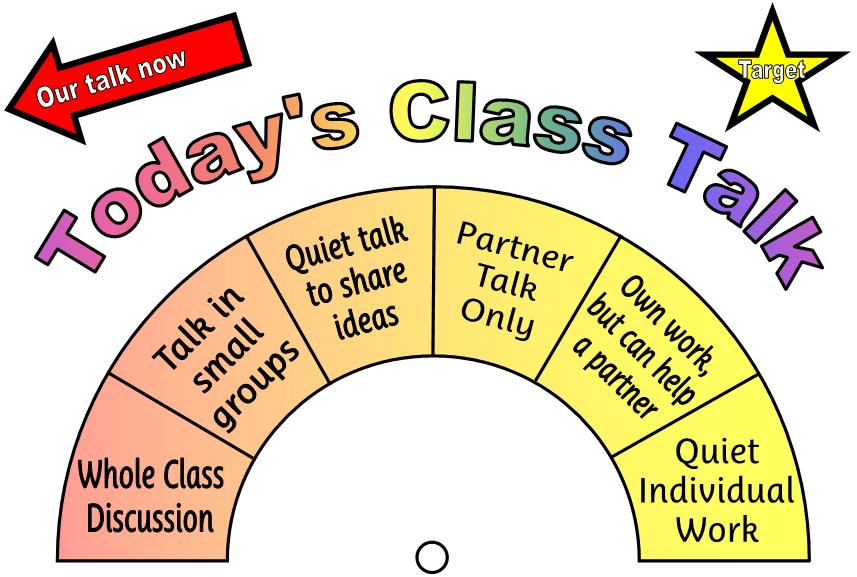
4- Use a variety of non-verbal signals: there are many examples of these online and in many books written about classroom management. Bring a small bell into class maybe, and ring it three times and wait, then two times and wait, until finally the class is quiet. Some teachers raise their hands up in the air, and everyone is expected to follow until they are all quiet. Some teachers put their hands on top of their heads, then touch their ears, noses and so on until all students start copying and return their attention to the teacher. There is also the infamous ‘noise-o-meter‘ to teach students to self-regulate the noise-level. These are just a few examples I came across. Of course, you will need to teach the students those procedures so they understand what is expected of them.
5- Use short and simple vocal cues to signal class: of course, there is the infamous “Stop… Look… Listen…”. Teachers often use this cue/signal with appropriate gestures, such as pointing at your eyes when saying “look” etc… Another one that I use often, especially when students are working in groups and get very loud, and I need to gather their attention back to me (I found this one in ‘The Effective Teacher’s Guide‘) Raise your hand and count off each finger saying, calmly but assertively:

  1. Stop what you are doing
  2. Mouth is quiet
  3. Look at your teacher
  4. Hands are still
  5. Listen for directions

These signals have the advantage of telling students how to behave or what is expected of them, as opposed to telling them not to do something.
6- Using the whiteboard: I often use the whiteboard to show recognition of positive behavior, or as a gentle reminder of what is expected. If I assign a certain task in class, I write two columns on the board: ‘students who appear to be on-task’ and ‘students who appear to be off-task’. Obviously, students want to get their name up on the former column, rather than the latter. Students who end up on the latter column know that this is their warning, and that consequences will follow if the behavior is not self-corrected. Obviously, this strategy needs to be updated regularly, as some students might end up on the ‘on-task’ list and then slack off. Positive rewards can also be put in place for students who are on-task for the whole lesson, though I do not necessarily like material incentives and prefer rewards like free-time or a choice of a game to play at the start of the next lesson.
7- Get students to teach: whenever I can, I try to ask students to research certain topics or concepts and then teach them to the rest of the class. Additionally, when some students are struggling with a certain concept, while some students have fully grasped it, make use of peer-tutoring and get them to teach the struggling ones.
8- Eat and drink the right stuff: I conducted a short informal survey at the school I work in, and most teachers barely drank any water during the school day! Water is very important for looking after your voice. Additionally, these teachers mostly had coffee or tea to keep them awake during the day. Caffeinated beverages dehydrate the body, coupled with insufficient water intake, and teaching all day, that’s a recipe for a strained voice. My reading has also made me realize that excessive intake of dairy products produces a lot of mucus and contributes to voice problems.

Of course, all of these tips and tricks are ones I learned from my reading, research and personal experience. I hope you find them useful! Please feel free to leave comments, as well as more tips and suggestions!

Additional reading:
Keeping Your Voice Healthy
Voice Care
How to look after your voice

Drama club are rehearsing!

We have started blocking our three plays and doing character development work. The three plays are looking very exciting and I am super-thrilled about sharing them with the students’ family and friends.

We have also been playing a lot of theatresports and improv games as there is an improv segment during the show-night!

We are all very excited 🙂

Ongoing student reflection?

When I started teaching Drama under the MYP Arts curriculum area, I had a few problems understanding what the IB-MYP meant when they wrote that reflection has to be ‘on-going’ in any MYP Arts course (refer to these excerpts from the IB-MYP Arts Guide to get what I mean). I felt very pressured to constantly come up with reflection questions for students. It took me a very long time to actually create a reflection structure and framework that satisfies the MYP requirements, is easy to explain to the students and is efficient to administer. Through careful reading, research and collaboration with MYP teachers in other schools, I came to understand that in the MYP Arts, Criterion C (Reflection and Evaluation) has three main strands:
1- the ability to reflect on progress, challenges and easies
2- the ability to evaluate own artwork (strengths and weaknesses)
3- the ability to receive feedback constructively

At first, I created a set of reflection questions that I would use with the students at the end of every lesson to prompt their reflection. But I wasn’t yet satisfied, as that required either writing up questions on the whiteboard and getting the students to copy them and answer, which is time-consuming; or printing worksheets with reflection questions, which is a waste of paper. Finally, I came across this wonderful website/blog by an IB Theatre/Drama teacher: The Black Box. I asked if I could borrow a reflection help-sheet that this teacher created, and I tweaked it so that it would better suit my class. This help-sheet includes sentence starters in four different categories: ‘strengths/easy/good/fun’, ‘weaknesses/hard/problems’, ‘improve’ and ‘feedback’. These four categories cover all the strands under Criterion C (Reflection and Evaluation). At the end of the lesson, I would allow the students some time to write their ‘four-sentence reflection’ on a piece of loose-leaf paper that they would keep in their portfolio. Here is a link to the reflection help-sheet and here is a photo of it:

20120920-091625.jpg

Once the students practice writing their four-sentence reflection a few times, I then assess Criterion C (Reflection & Evaluation) using a task-sheet. This task sheet requires them to watch a video recording of their performance, write their four-sentence reflection, conduct a self-assessment of their work through a checklist, and then write up a performance evaluation:

20120920-091634.jpg

The students are then also asked to self-assess themselves on their ability to reflect and evaluate using this modified rubric (they give themselves a mark out of 8 in the Student’s Self-Assessment column):

20120920-091640.jpg

I also make use of reflection to help me assess other criterion, by allowing students to evaluate and self-assess themselves. For example, in this task below, the students create an improvised performance, watch a video recording of themselves performing, self-assess their skills and techniques using a checklist, and then give themselves a mark out of 10 for Criterion B (Application):

20120920-091649.jpg

Student self-assessments and self-evaluations are a form of reflection, and I make use of them when gathering data to assess Criterion D (Personal Engagment). Here is a modified version of a group-work self-evaluation I found on this website: TeacherVision. I use this self-evaluation to assess ‘ability to work actively and supportively with peers’ which is one of the strands under Criterion D (Personal Engagement):

20120920-091655.jpg

Another attitude I am often interested in assessing is ‘Audience Etiquette’ or ‘Audience Skills’. To gather data about this attitude, I also make use of the following self-evaluation:

20120920-091700.jpg

These are all examples of how I use written reflections in my drama classroom. We also carry out a great deal of oral reflection and evaluation in the class. For example, after every drama game or warm-up, we reflect orally and debrief on what was the benefit of this game/warm-up and what skills do we practice by playing it. Additionally, after every performance, some students are selected to step into the ‘director’s shoes’ and give positive feedback or useful suggestions. Lastly, performers themselves are asked to deliver a short oral explanation of their performance and how they worked in the group, what they found challenging and what was easy.

I believe I have finally fulfilled the MYP requirement of having ongoing reflection. The students are constantly reflecting orally, in addition to carrying out at least one form of written reflection every lesson: four-sentence reflections, or self-assessment checklists, or performance self-evaluations, or self-assessments of attitudes, in addition to allowing them the opportunity to self-assess each of the MYP Arts Criteria of Assessment.